
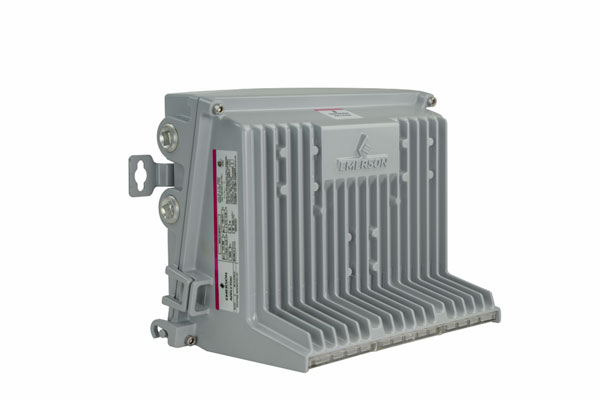
Emerson has launched an energy-efficient alternative to conventional HID wall pack lighting fixtures with its new Appleton Wallmaster LED Series wall pack luminaires specially engineered for hazardous industrial environments.
Available in five lumen outputs equivalent to HID wattages from 70W to 400W, Appleton Wallmaster LED luminaires consume as much as 80% less electricity than an HID without sacrificing brightness, paving the way for lower operational costs across a range of industries. An impressive 102,000-hour service life further reduces expenses by decreasing maintenance needs and eliminating unplanned downtime.
Industrial LED lighting has reached an inflection point with an estimated 40% of North American plants having upgraded from traditional light sources to LED. However, in classified or hazardous locations, LED adoption has been much slower due to the need for extremely rugged, highly specialized fixtures. Appleton has tackled those challenges by offering more than 40 LED luminaires designed for hazardous locations, the latest being the new Wallmaster LED Series.
Appleton Wallmaster LED wall pack luminaires are perfect for installation above doors, along building exteriors, stairways, tunnels, loading docks, and other areas where illumination over wide areas adjacent to walls is required. They combine Type III medium light distribution with an available lumen range of 3,500 to 12,000 lumens, ensuring excellent visibility while minimizing glare and light pollution. Not only do the luminaires reduce dangers in industrial spaces, but a choice of color temperatures and 10% to 100% dimming levels contributes to other benefits like reduced eye strain and enhanced worker well-being.
Engineered for CID2 locations
Appleton Wallmaster LED Series luminaires are engineered for areas classified by the National Electrical Code (NEC) as “hazardous” due to the presence of flammable gases, vapors or liquids. Specifically, the new luminaires meet NEC/CEC Class I, Division 2 (CID2) standards for the safe deployment in a variety of industrial locations, including petrochemical, chemical, and LNG plants, utilities, wastewater treatment facilities, foundries, pulp and paper mills, and oil and gas refineries.
In addition to CID2 sites, Appleton Wallmaster LED Series luminaires are suitable for harsh non-hazardous NEMA 4X areas, outdoor installations, and maritime applications, thanks to an IP66-rated aluminum housing and light guard, epoxy powder coating, an impact- and thermal-resistant polycarbonate lens, and stainless-steel bolts, safety cables, and mounting brackets. Enclosed and gasketed, Appleton Wallmaster LED luminaires demonstrate unparalleled resistance against corrosion, dust, moisture, and extreme temperatures.
At this time, Appleton Wallmaster LED Series luminaires are pending DarkSky approval due to their ability to reduce light pollution, glare, and light trespass.
With a lightweight, low-profile footprint, Appleton Wallmaster LED Series luminaires can be quickly mounted vertically up to 25 feet. With a two-piece hinged clamshell enclosure that has a detachable front housing that provides access to wiring and field-replaceable LED drivers, this design maximizes labor savings.
If needed, an optional emergency battery backup version of the wall pack can also be ordered. It provides up to 1450 lumens of illumination for 90 minutes or 800 lumens of illumination for 180 minutes of emergency lighting.
Yet another benefit is connectivity. Up to 10 Appleton Wallmaster LED Series luminaires can be daisy-chained and controlled by Appleton Areamaster Connect or Mercmaster Connect luminaires. This connectivity enables Areamaster and Mercmaster Connect’s energy-saving capabilities to be shared with the Wallmaster group, including advanced daylight harvesting, motion sensing and scheduling, as well as remote monitoring using the Emerson Plantweb Insight Connected Lighting app.
In addition to the Wallmaster, Appleton is introducing the Ordinary Location rated IWH LED Wall Pack series carrying the identical rugged environmental ratings without the CID2 hazardous rating.
Source: Appleton